3 hours without power: what would it cost your production?
In a power outage, the interruption itself is often the smaller problem – the restart, with scrap, delivery delays and unclear priorities, is what gets expensive. Learn why companies should know their energy and production dependencies and how empAI creates the transparency to assess risks and decide faster in an emergency.
3 hours without power. What would it cost your production?
Probably more than three hours of production. Because the outage is the smaller problem. The bigger one starts when the power comes back: with the controlled restart, scrap, delayed deliveries, unclear priorities and the question of which processes need to be available again first.
The key question is therefore not only: how likely is a power outage?
But: how well does a company know the impact on its own production?
A growing risk for industrial processes
The power supply in Germany and Europe is among the most stable in the world. For industrial companies, however, average grid stability is only part of the picture. What matters is what happens when a disruption occurs.
After a power outage, complex production plants often take considerably longer to restart than the actual interruption lasted. Dependencies between plants, process steps and supply systems can turn a few minutes without energy into a production outage lasting hours or even days.
It doesn't matter whether the cause is a technical defect, a weather event, an overload or an infrastructure failure: what matters is how well prepared the company is for the situation.
Three developments are changing the requirements for energy supply
Industrial energy supply is becoming increasingly complex. The expansion of decentralised, weather-dependent energy generation is changing the requirements for planning and control. At the same time, geopolitical developments are creating new dependencies in energy supply and critical infrastructure. Cybersecurity is also becoming more important in view of increasing attacks on networked systems.
None of these factors automatically means that a large-scale power outage is imminent. Together, however, they show: companies need to better understand their dependencies and risks.
The key question: what happens in an outage?
Many companies can measure their energy consumption today. But do they also know the concrete impact of an outage?
- Which plants are particularly critical?
- Which processes can be interrupted at short notice?
- Which production steps cause the highest follow-up costs?
- How long does a restart actually take?
- Which priorities should apply in an emergency?
The necessary data already exists in many companies: energy meters, sensors, ERP and MES systems provide information on consumption, production and processes.
The challenge is not to collect more data. What matters is connecting the existing information and using it to build a reliable picture of operational dependencies.
An energy meter shows consumption. An MES shows production data. An ERP shows orders and planning. Only the combination of this information shows what impact an energy outage actually has on costs, delivery capability and production priorities.
How empAI helps
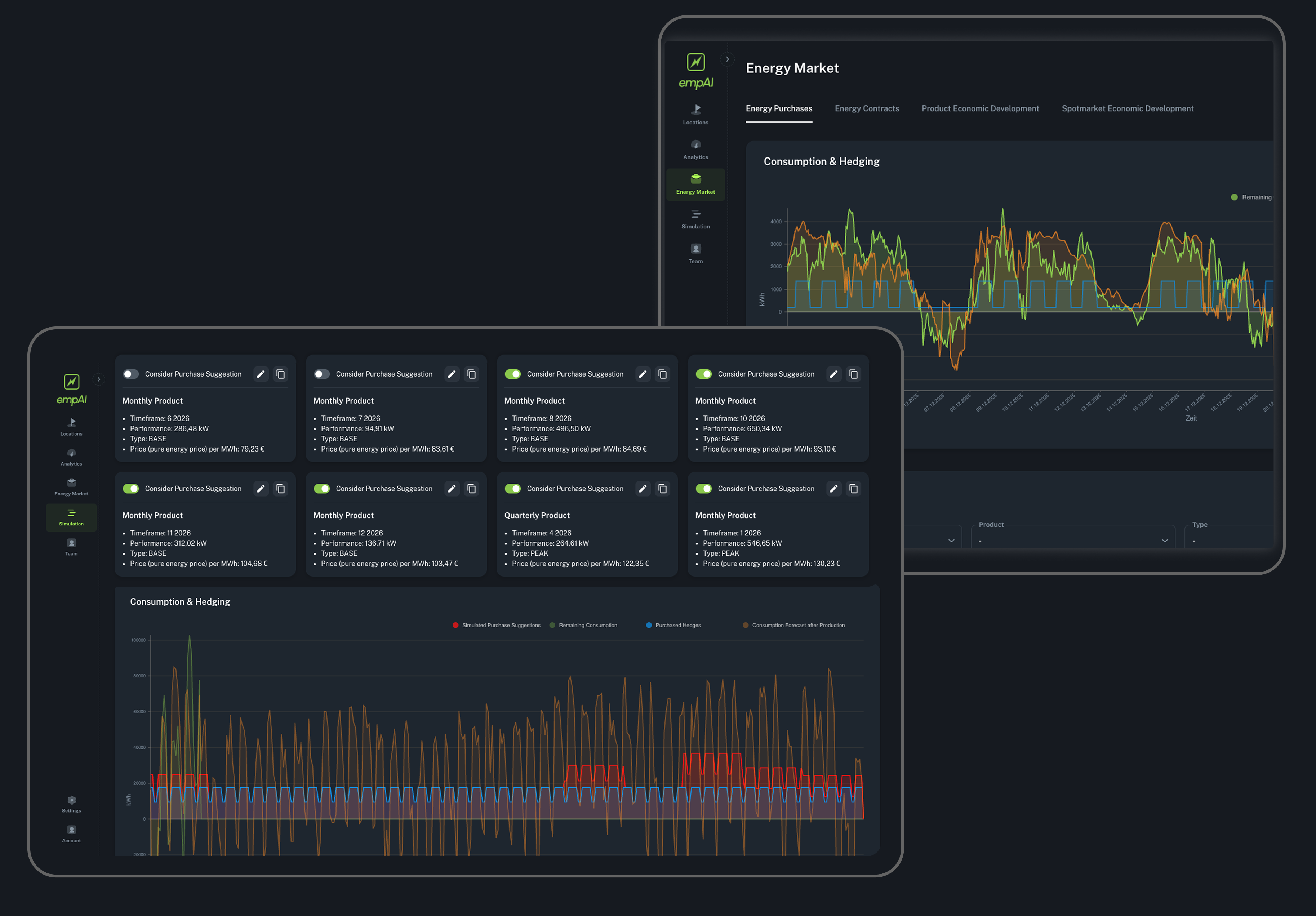
empAI connects energy, production and process data in a shared model. This allows companies to make relationships visible, assess scenarios and make well-founded decisions – for example:
- which plants are particularly critical in an emergency,
- which production areas should be secured as a priority,
- what costs an outage could cause,
- which processes depend particularly heavily on energy availability.
empAI does not replace an emergency power supply and does not prevent power outages. However, the platform creates the transparency needed so that companies don't have to find out in an emergency what consequences an interruption has for them.
Conclusion: decide instead of just reacting
When the next major power outage will hit a company cannot be reliably predicted. Whether a company then knows which processes are affected, what impact arises and which measures have priority, however, can be prepared.
The basis for this is connected data and a clear understanding of your own energy and production dependencies.
With empAI, companies get exactly this transparency: a reliable data foundation to better assess risks, make decisions faster and sustainably increase the resilience of their production.