Energy data management in the aluminium industry
14,500 kilowatt hours per tonne: where is there still room for manoeuvre in aluminium production?
When energy demand can hardly be reduced any further, planning determines costs and competitiveness.
Around 14,500 kilowatt hours of electricity go into a single tonne of primary aluminium. That corresponds to the annual consumption of more than three four-person households.
And this demand cannot be reduced at will. Primary aluminium – aluminium obtained directly from the raw material bauxite rather than from scrap – is produced by fused-salt electrolysis: using large amounts of electricity, aluminium oxide is converted into metallic aluminium – around the clock. The International Aluminium Institute accordingly counts the power supply among the key variables of primary production. Remelting, casting and rolling also require high temperatures and stable processes.
At the same time, external pressure is growing: high energy and raw material costs, international competition and rising requirements for decarbonisation, the circular economy and CO₂ transparency.
The key question is therefore: how can the energy that production absolutely needs be used so precisely that consumption and costs go down?
An industry under pressure
Efficiency has long been an important topic in the aluminium industry. According to the German Environment Agency (Umweltbundesamt), energy consumption in the non-ferrous metals industry has already fallen significantly since the mid-1990s thanks to process optimisation and heat recovery. In many places, the easily realisable potential has already been tapped.
At the same time, the economic environment remains tense. According to the latest economic report by Aluminium Deutschland, production of semi-finished aluminium products fell by two percent to just under 1.15 million tonnes in the first half of 2026. Recycling also declined by two percent overall to around 1.36 million tonnes. Weak demand, high location and input costs and tight raw material markets characterise the picture.
When sales and margins are under pressure, every kilowatt hour becomes a cost issue – in the rolling mill as well as in the foundry or at the recycler.
Recycling and technology: important levers with limits
The biggest lever for lower energy demand is recycling. Aluminium can be remelted again and again. According to the German Environment Agency, production from secondary raw materials saves around 95 percent of the energy compared with primary production – with a direct effect on the carbon footprint.
However, recycling cannot fully replace primary production. The availability of suitable scrap, different alloys and high quality requirements set limits.
Technical optimisation is also continuing: more efficient plants and processes, better heat recovery and lower losses in power transmission reduce the energy demand of individual processes.
Even with such measures, energy demand remains high. This brings a second level into focus: forward-looking management of the energy that is still needed.
Efficiency also means: at the right time, in the right place
A total figure shows how much energy a site consumes. It does not show which plants cause the consumption, when load peaks occur and which processes offer any room for manoeuvre at all.
Then there is the time dimension. Electricity prices fluctuate over the course of the day, and self-generated renewable energy is not always available. While electrolysis has to run continuously, holding furnaces, compressed air, cooling or storage, for example, can be operated differently or shifted in time within operational limits.
To use this room for manoeuvre, companies need to know their energy use in more detail than before. This includes knowing which plants account for the largest share of consumption and when and why load peaks occur. Equally important is distinguishing which processes must run continuously and which can be shifted in time. And finally, there is the question: how do fluctuating electricity prices affect your costs per tonne?
Energy efficiency means aligning energy use more closely with production, availability and costs.
The data is there, only the connection is missing
An aluminium plant already generates a large amount of data. Energy meters provide consumption values, machines record operating states, ERP and MES systems contain production plans, orders and quantities. Added to this are energy prices, weather data and information on self-generation and storage.
In most plants, the necessary data already exists. The decisive step is to connect it (more on this in the article "Energiedaten: Warum ‚erfasst' noch lange nicht ‚verfügbar' bedeutet").
An energy meter shows that consumption has risen. Only with production data does it become clear which process was responsible. Only with price data does it become visible what it cost. And only a comparison over longer periods shows whether this is a normal pattern or a starting point for optimisation.
How empAI helps
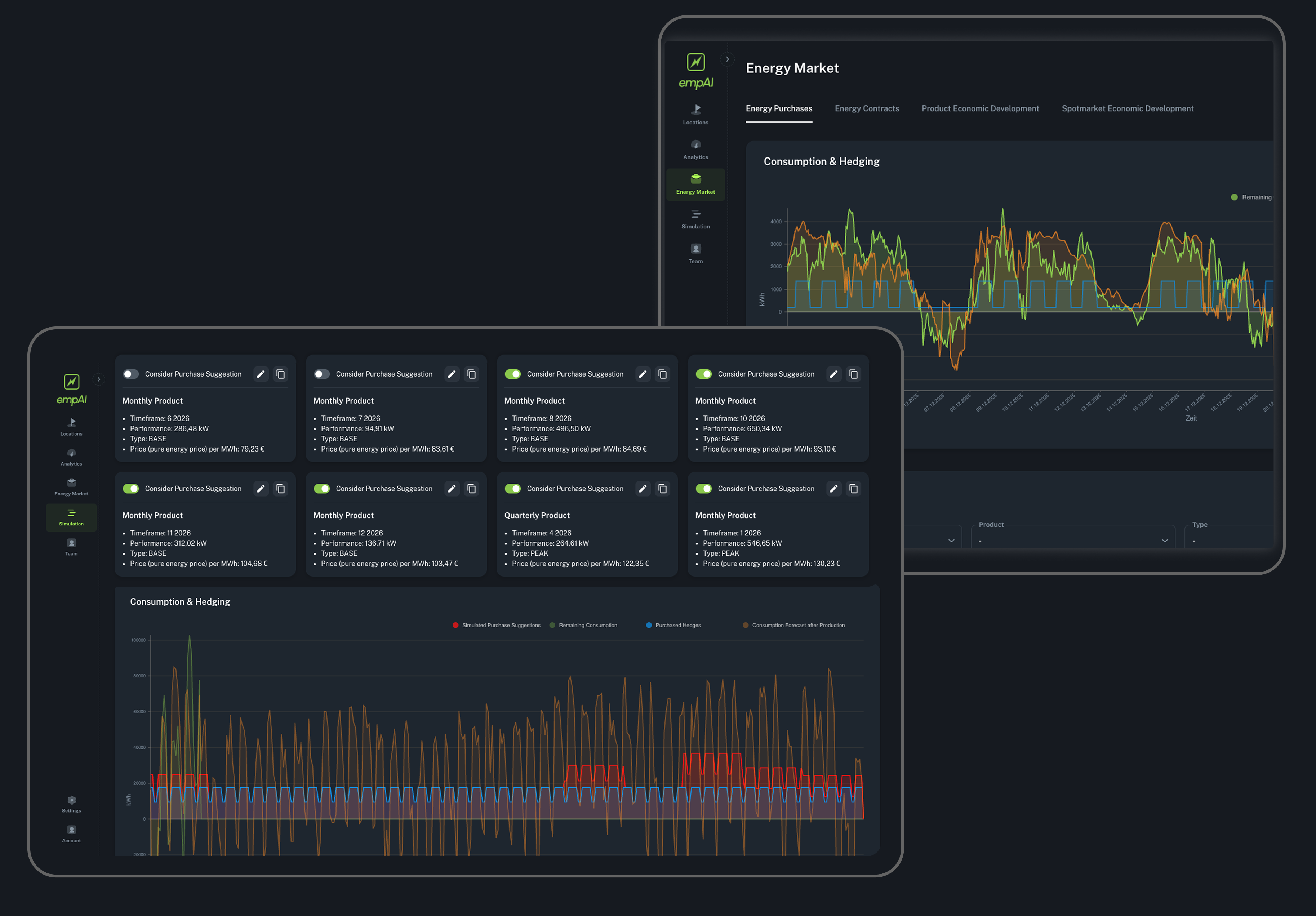
empAI is an AI platform for energy-intensive production. It brings together energy, production, market and environmental data from sensors, smart meters, ERP, MES, weather services and energy markets in digital twins. On this basis, relationships can be analysed, developments forecast and scenarios compared.
For the aluminium industry, this results in five fields of application:
1. Understanding energy consumption down to plant level
Instead of looking only at a site's total consumption, empAI links energy and production data. This shows you which areas, plants or processes account for which share of energy demand and when, so you can target efficiency measures and check their effect.
2. Anticipating consumption and energy prices
empAI's AI forecasting layer considers consumption, self-generation and market data together. This lets you estimate your energy demand earlier and link it to developments on the energy market. With a high base load, even better predictability is economically relevant.
3. Realistically assessing load peaks and flexibility
empAI evaluates energy and production data together, makes critical consumers visible and detects load peaks early. The aim is not to shift as many processes as possible, but to find the flexibility that actually exists, for example in furnaces or storage.
4. Simulating measures before implementation
What happens to consumption and costs if a production period is shifted? What does additional storage bring? How does self-consumption change with a different operating mode? With what-if scenarios, you first evaluate options in the digital model before intervening in sensitive production processes.
5. Looking at energy and CO₂ together
In the aluminium industry, energy source and carbon footprint are closely linked: how climate-friendly primary aluminium is depends largely on how the electricity used is generated. Accordingly, energy supply and decarbonisation are among the industry's key topics. empAI brings together energy and CO₂ data at product, process and site level and makes it available for analysis and reporting.
Conclusion: plan, don't just save
The aluminium industry will continue to need large amounts of energy in the future. The physical requirements of production cannot be overridden by software. That is precisely why it is important to know the available levers in detail.
Recycling significantly reduces energy demand, technical innovations reduce losses, renewable energy improves the carbon footprint. And intelligent energy data management creates the transparency to better align the remaining demand with production, the market and available flexibility.
empAI gives companies the foundation for this: bringing existing data together, making relationships visible, assessing developments in advance and comparing options for action. This makes energy consumption more transparent, more predictable and easier to control within operational possibilities.