Energy data: why "captured" is far from "available"
Industrial companies capture more energy and production data today than ever before – and yet a quick overview is often missing. Learn why real value only emerges when energy, production and environmental data are connected, and how empAI turns scattered information into a shared data foundation for analysis, reporting and well-founded decisions.
Energy data in companies: why "captured" is far from "available"
Industrial companies have more energy and production data at their disposal than ever before. Meters, machines and a range of systems continuously record what happens in production. Even so, a quick overview is often missing.
Because industrial energy management shows time and again: capturing data is not the same as making it available and usable.
What matters is not only how much information exists, but whether it is connected and available at the right moment. This is one of the central challenges of effective energy data management.
Lots of data, but no shared overall picture
Energy-intensive production continuously generates large volumes of data. Energy meters record consumption, production systems document machine and plant data, and other systems provide information on orders, utilisation or operating hours.
This fragmented data can already be valuable. Its real benefit, however, often only emerges once it is connected.
A total consumption figure on its own says little about what caused it. The information only becomes interesting in the context of production: Which line was running at the time? Which product was being made? Which plant consumed a particularly large amount of energy? How do individual shifts or production periods differ?
If the information needed for this is spread across different systems, files and data sources, even a simple analysis takes considerable effort and costs valuable working time. Outside operational energy management, too, energy data – for example for internal cost analyses, customer requests, energy audits, ISO 50001 documentation or reporting obligations under the CSRD and the German Energy Efficiency Act (EnEfG) – often first has to be gathered from various sources and prepared before a meaningful analysis is possible.
From data collection to energy transparency
Functioning energy data management therefore does not start with yet another report, but with a shared data foundation.
Energy, production and environmental data must be connected in such a way that individual measurements form a clear, traceable picture of production. Only then can energy consumption be viewed in its actual operational context.
This is exactly what empAI is designed for.
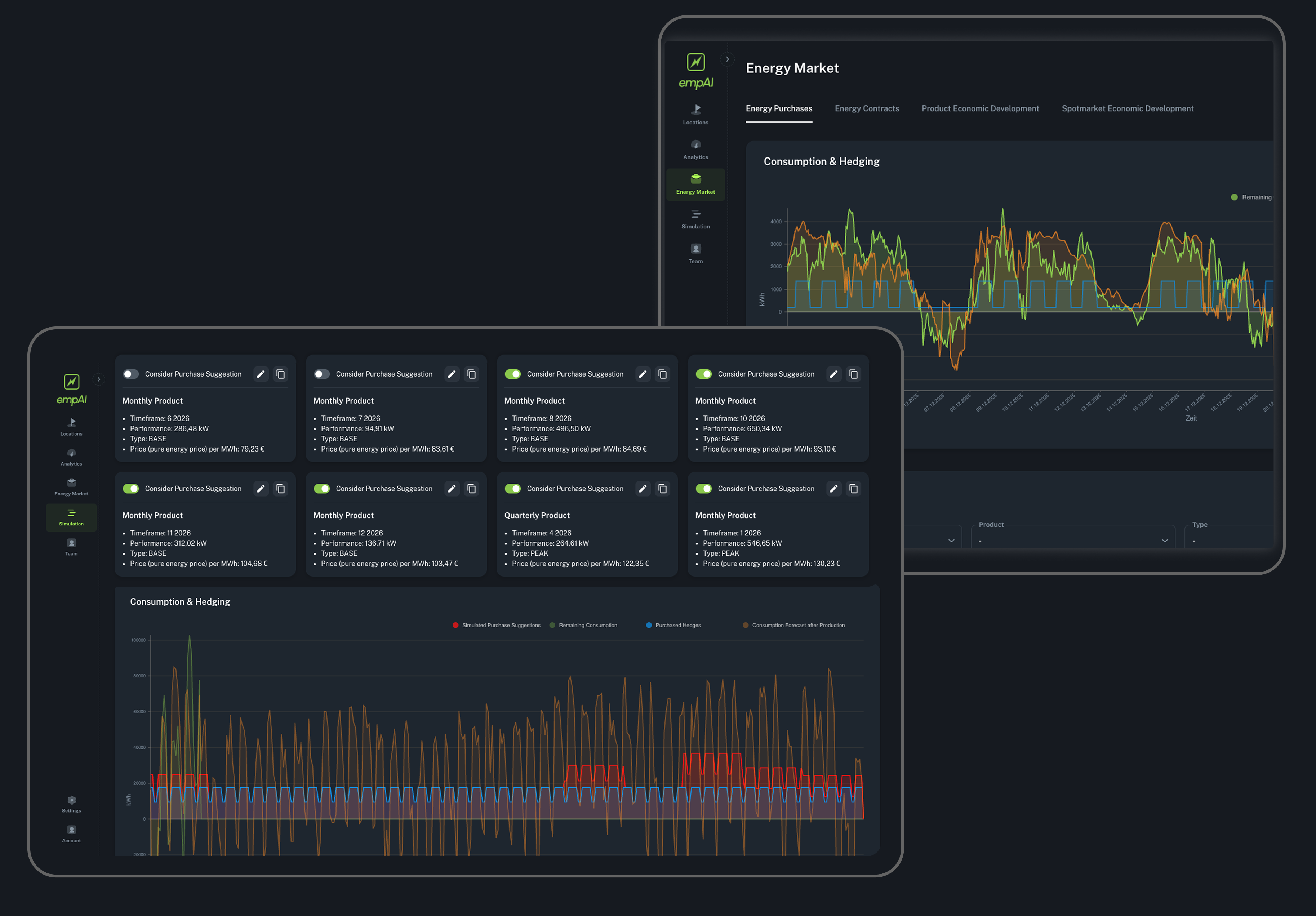
empAI is an AI platform for energy-intensive production that continuously brings energy, production and environmental data together in digital twins. The result is a digital representation of production that is always available and can be analysed from different perspectives.
Instead of gathering data again for every new question, consumption can be viewed by site, production line, product, shift or time period, for example. Scattered information becomes a shared data foundation.
The key question is not just how much energy is consumed
With such a data foundation, the way companies can look at their energy consumption also changes.
The question "How high was our energy consumption?" then becomes merely the starting point. Building on it, far more specific relationships can be examined:
- Which sites or production lines have the highest energy demand?
- How does consumption change between different shifts?
- Which products or production processes are particularly energy-intensive?
- When do unusual consumption patterns or load peaks occur?
- How are production utilisation and energy demand related?
- Where are there concrete starting points for more efficient energy use?
This turns energy data management into more than just documenting consumption. Existing data becomes a basis for operational and strategic decisions.
Reporting doesn't have to take days
A central data foundation also has a practical advantage: information no longer has to be tracked down again for every request.
Whether for an internal cost analysis, a customer, an audit or evidence related to energy management and regulatory requirements – the required information can be provided directly from the existing data foundation.
This not only reduces manual effort. It also improves traceability, as analyses are now based on a consistent data foundation. Reporting thus shifts from a recurring task of searching, merging and preparing to an integral part of ongoing energy data management.
Energy data only unfolds its value once it becomes usable
Today, industrial companies do not necessarily need to collect more data. In many cases, the crucial information already exists. The challenge is to bring it together and make it usable for day-to-day operations.
With empAI, scattered energy, production and environmental data becomes a shared data foundation. Companies not only gain a central overview of their consumption, but can also recognise relationships within production, produce analyses faster and make decisions based on current data.
In this way, energy data management evolves from the laborious gathering of individual pieces of information into a continuous tool for greater transparency and more efficient processes.